
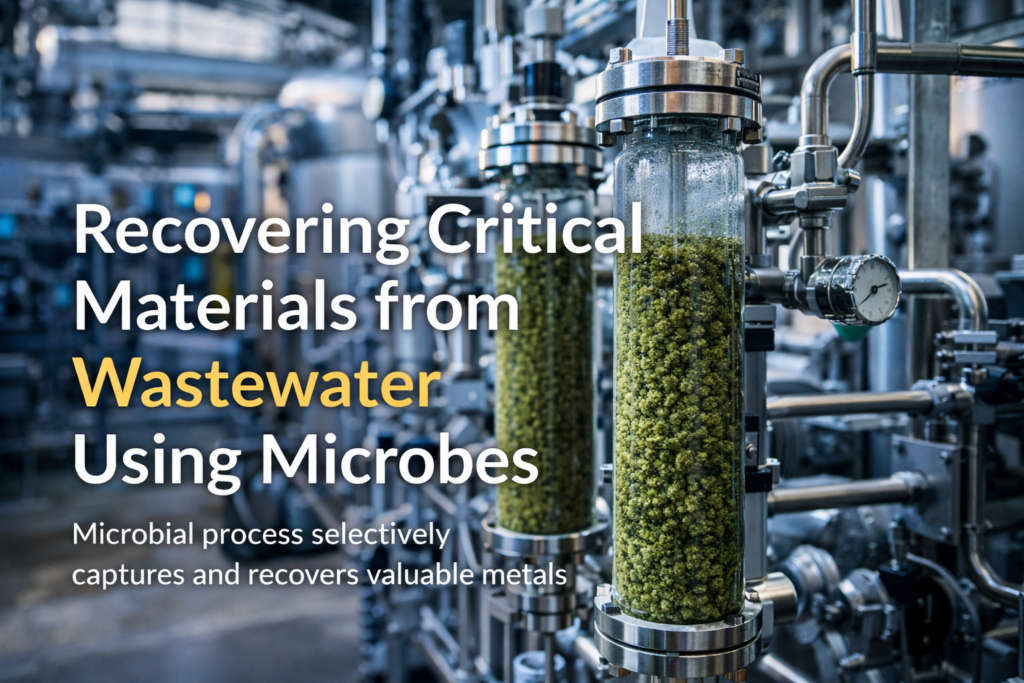
Removing (and recovering) critical materials from wastewater using microbes
Many industrial wastewaters contain trace-to-moderate concentrations of valuable “critical” materials. Microbial processes—especially biosorption—can capture dissolved metal ions, then release them into a smaller-volume stream for downstream concentration and product recovery.
What does “microbial recovery” mean?
Here, microbes (or microbial biomass) act as a selective capture medium—binding metal ions via surface functional groups through physicochemical mechanisms such as adsorption, ion exchange, and complexation. A key design goal is that capture can be reversible, enabling regeneration and repeated cycles.
What “critical materials” can be targeted?
“Critical materials” vary by sector and supply-chain needs. Wastewaters and brines may contain recoverable ions such as:
- Lithium (e.g., certain brines/produced water contexts)
- Rare earth elements (REEs)
- Cobalt and nickel (battery/alloy supply chains)
- Other metals depending on the source stream and site economics
Why use microbes at all?
Microbial and bio-based capture methods are often explored because they can:
- Bind metals at low concentrations (where purely physical methods may be less effective)
- Operate as modular unit operations (e.g., packed columns) that can be cycled and regenerated
- Complement pretreatment, membranes, thermal steps, and precipitation rather than replacing them
A typical high-level process flow
One published approach describes a treatment train that combines pretreatment, a biosorption column, regeneration/desorption, and concentration + recovery steps—supporting reuse-quality water while producing a smaller, higher-value recovery stream.
Reduce fouling/scaling drivers and manage organics that can interfere with selective metal capture.
Flow through a fixed-bed column where immobilized microbial biomass reversibly binds target ions.
Elute captured metals into a smaller-volume stream using controlled chemistry, then regenerate the biosorbent.
Concentrate and convert the eluate into a recoverable form (e.g., precipitation and collection).
How this integrates with wastewater operations
Microbial recovery is typically a bolt-on module within a broader treatment train:
- Upstream pretreatment helps preserve capture efficiency and stability
- Core capture module selectively partitions target ions into an eluate
- Downstream polishing supports reuse-quality water while conditioning the recovered stream
Other microbial pathways (beyond biosorption)
Depending on the wastewater chemistry and objectives, other microbially driven approaches may be evaluated:
- Biogenic sulfide precipitation (microbially generated sulfide can precipitate some metals)
- Bioelectrochemical systems (emerging platforms coupling microbes + electrodes for recovery)
FAQ (high-level)
Is the biomass “alive,” and does it have to be?
Biosorption often relies on metal binding to microbial surface functional groups. Depending on the design, biomass can be living, dormant, or otherwise stabilized/immobilized—selected for repeatable capture and regeneration.
What makes a biosorption process “selective”?
Selectivity depends on binding-site chemistry, operating pH/ionic strength, competing ions, and the capture–elution strategy. Pretreatment frequently improves robustness by reducing interference from organics and scaling drivers.
Does this replace conventional treatment?
Typically no. It is often integrated into a broader train: treat for reuse-quality water while producing a recoverable metals stream.
References (published patents & high-level abstracts)
Included for transparency and further reading.
- US 2024/0368012 A1 — Devices, Systems, and Methods to Facilitate Critical Metal Extraction from Water
- US 2019/0010068 A1 — Pretreatment of Produced Water to Facilitate Improved Metal Extraction
- Microbial biosorption mechanisms overview (chapter preview)
- Review abstract: sulfate-reducing bacteria and biogenic sulfide precipitation for metal recovery
- Review abstract: bioelectrochemical systems for wastewater treatment and resource recovery